How to Build an AI SEO Content Workflow That Turns Keywords Into Publish-Ready Blog Posts

An effective AI SEO content workflow is a systematic process that uses artificial intelligence to accelerate research, outlining, and drafting, while relying on human editorial judgment for factual accuracy, brand voice, and search intent. For Shopify store owners, SEO managers, and small marketing teams, scaling content production often feels impossible without a massive editorial budget. However, treating AI as an automated "content factory" that publishes raw drafts leads to thin, generic pages that fail to rank. The most successful teams use AI as a high-speed drafting layer—automating the first 60% of the work—so human editors can spend their time on the final 40% that actually drives conversions and satisfies search engines.
The 60/40 Rule and the 6-Month AI SEO Test
A common debate in SEO automation is whether to push AI-generated content directly to a Content Management System (CMS) or mandate a human review. While technical setups allow for 100% automation, search engine guidelines regarding Experience, Expertise, Authoritativeness, and Trustworthiness (E-E-A-T) make raw AI publishing a significant risk.
A documented 6-month industry test by SEO expert Victoria Olsina provides concrete data on this balance. By implementing a hybrid AI-human pipeline, her team increased content output from 2-3 articles to 8-10 long-form articles per month without sacrificing depth or rankings. The study concluded that AI excels at structural tasks—clustering keywords, analyzing Search Engine Results Pages (SERPs), and generating outlines—but fails entirely at providing original insights.
This birthed the "60/40 rule" of AI content creation. The workflow dictates that AI should handle the heavy lifting of data processing and initial drafting (the 60%), leaving the human editor to inject brand-specific scenarios, compress repetitive fluff, and verify facts (the 40%).
Building a High-Converting AI SEO Content Workflow
To achieve high rankings, you must move away from single-prompt generation (e.g., "Write a 1,500-word SEO blog post about X"). Modern workflows use a multi-step, node-based approach that breaks the writing process into distinct, manageable stages.
Step 1: Keyword Intent and Competitor Scraping
A high-ranking article begins outside of the AI interface. Feeding a raw keyword into a language model forces the AI to guess the search intent, resulting in generic output. Instead, the workflow must start with traditional SEO validation using data tools to confirm search volume and intent.
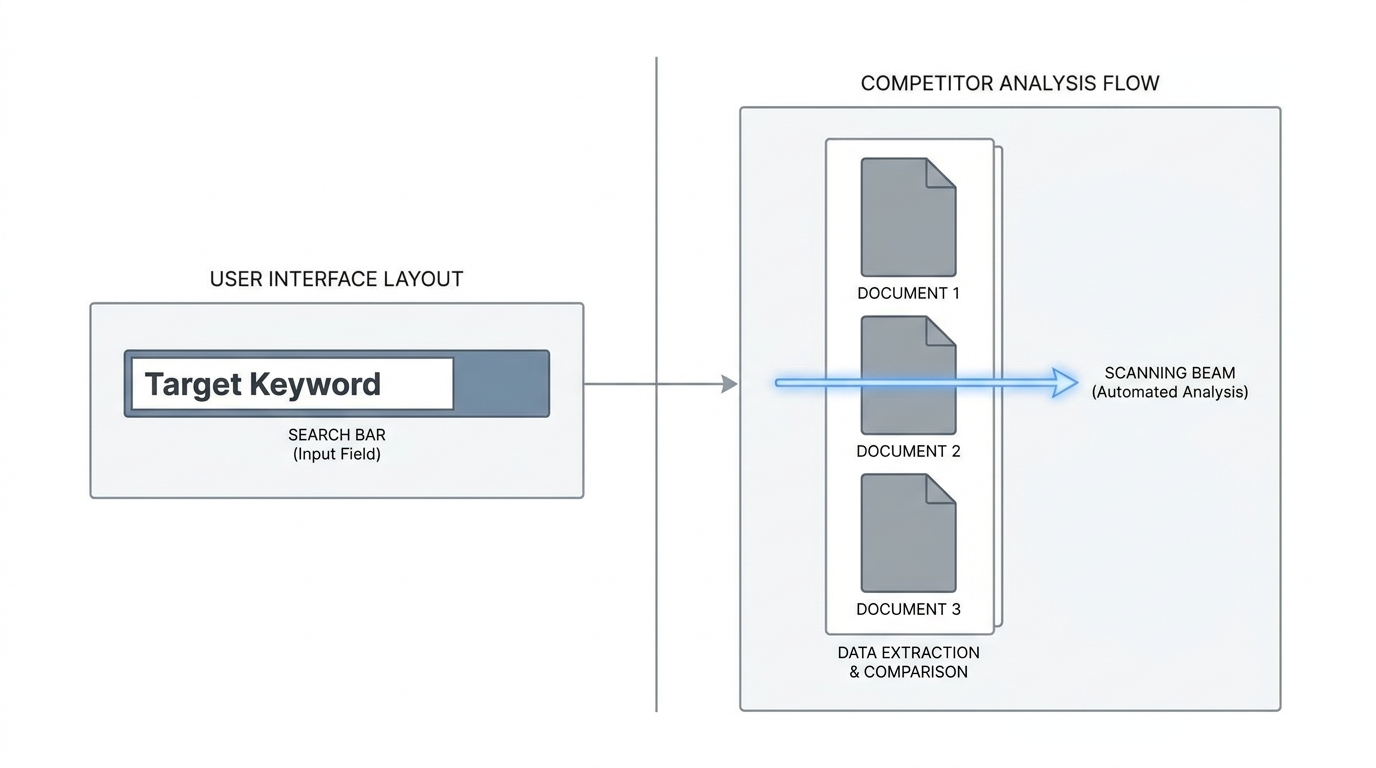
Once a target keyword is identified, the next step is competitor-aware generation. Automated workflows can be configured to scrape the text of the top three ranking articles on Google for that specific keyword. By feeding these competitor transcripts into the AI alongside your target keyword, you provide a factual baseline. The AI is instructed to analyze the existing content gaps, identify common questions the competitors failed to answer, and structure a more comprehensive resource.
Step 2: Multi-Step AI Generation (The Agentic Approach)
When you generate articles from keywords, breaking the process into distinct, sequential tasks ensures higher quality control. A proper prompt structure should always include the Role, Topic, Keywords, Structure, and Constraints.
The workflow should follow this sequence:
- The Briefing Node: The AI generates a proposed title (H1) and a semantic outline (H2s and H3s) based on the competitor data.
- The Drafting Node: The AI writes the article section-by-section rather than all at once. This prevents the model from losing context, hallucinating, or rushing the conclusion.
- The FAQ Node: The AI generates a dedicated Frequently Asked Questions module at the end of the post to capture long-tail semantic search queries.
Step 3: Structuring for Dual-Audience Optimization
Content must now be optimized for two distinct audiences: traditional search engine crawlers (Google) and AI Answer Engines (like Google's AI Overviews or ChatGPT citations).
To satisfy both, the AI output must be highly structured. Answer engines favor "entity clusters" and factual density over simple keyword repetition. Instruct your AI to include direct, one-sentence answers to core questions immediately beneath H2 headings.
For human readability, the workflow must enforce strict formatting rules. AI naturally writes in long, dense paragraphs. Your prompts should force the AI to break up text using bulleted lists, pros/cons comparison tables, and short paragraphs. Adopting a narrow screen layout (600-800px width) with a right-side Table of Contents (TOC) significantly improves user experience and provides SEO anchor links that search engines use for featured snippets.
Step 4: Building the Operational Pipeline and Memory
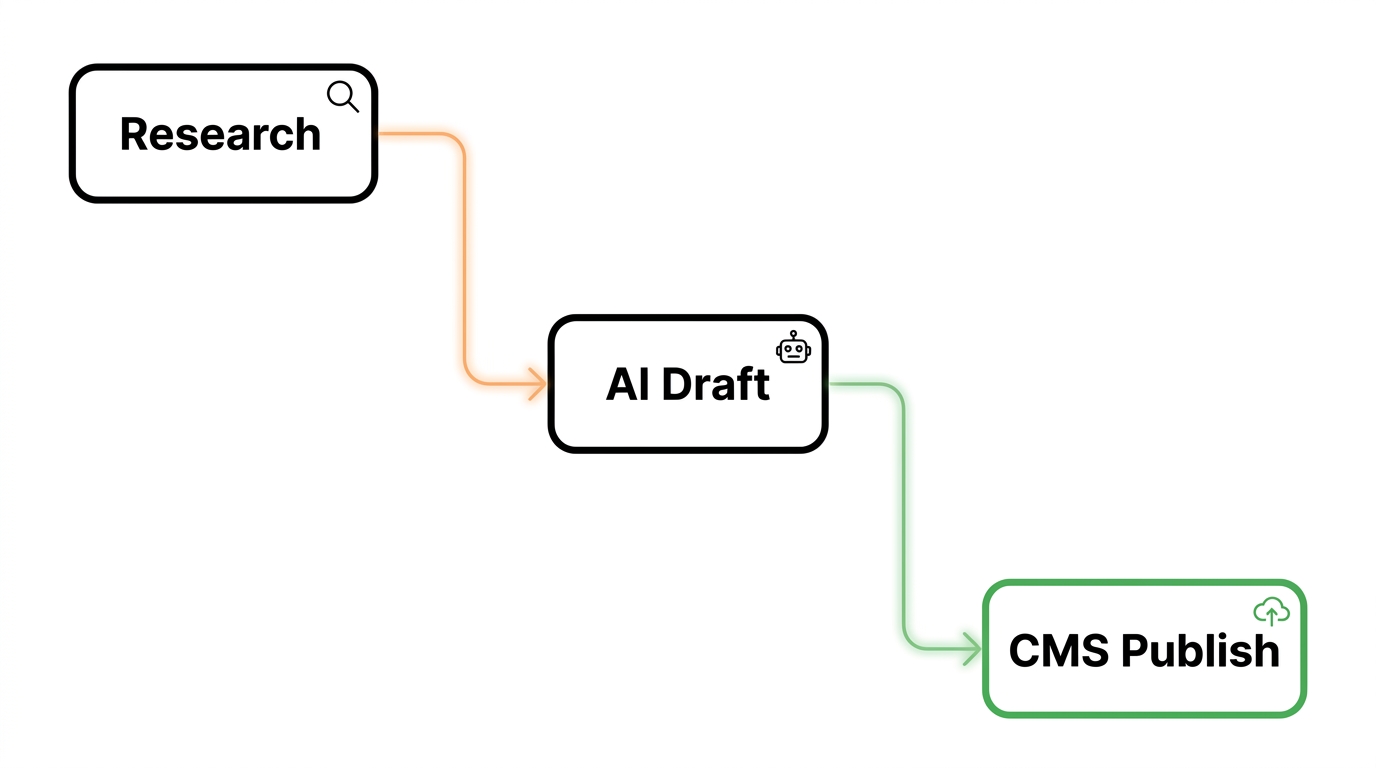
Scaling this process requires an operational system that connects your research tools, your AI models, and your CMS.
Setting up an AI SEO content pipeline requires a persistent memory to ensure the AI maintains your brand voice and doesn't duplicate topics over time. Visual workflow demonstrations from technical SEOs show that developers often use local storage environments—such as running AI extensions directly within code editors like Visual Studio Code—to save every generated outline and article into a local folder. This creates a persistent content library that the AI can reference to prevent topic duplication.
For non-technical teams, this means utilizing "Knowledge Bases" within your AI tools. Before generating a single post, upload your site map, brand guidelines, and product PDFs. This forces the AI to internally link to your existing product pages accurately and write in a tone that matches your brand, rather than relying on its default, robotic voice.
The 15-Minute Pre-Publish Human Review Checklist
To ensure the content is publish-ready, every AI-drafted article must pass through a strict human review. Use this checklist to standardize the 15-minute polish:
📺 How To Create A Fully Automated AI SEO & Content Agent ...
| Review Category | Action Required |
|---|---|
| Search Intent | Does the introduction immediately answer the user's core question without unnecessary background fluff? |
| Fluff Compression | Delete repetitive transitional phrases (e.g., "In conclusion," "As we navigate the world of..."). |
| E-E-A-T Injection | Add at least one original data point, customer quote, or proprietary brand image that the AI could not have known. |
| Formatting Check | Are there bullet points, a comparison table, and a Table of Contents? Are paragraphs kept under 3-4 sentences? |
| Internal Linking | Verify that the AI-generated internal links point to live, relevant product pages or pillar posts on your site. |
What to Ignore in AI SEO Advice
- "100% Hands-Free Auto-Publishing": Ignore tutorials that promise you can connect an AI directly to your Shopify blog and walk away. Auto-publishing without a human review stage inevitably leads to hallucinated product features, broken links, and a drop in domain authority. Always push AI content to "Draft" status.
- "Single-Prompt Generation": Disregard tools or guides that claim to write perfect, long-form SEO articles from a single sentence prompt. High-ranking content requires a multi-step, modular generation process.
- "Keyword Density Targets": Ignore advice that tells you to force the AI to use a keyword a specific number of times. Modern SEO relies on semantic relevance and topic clusters, not keyword stuffing.
Frequently Asked Questions (FAQs)
How much does an automated AI SEO workflow cost?
While many tutorials frame AI workflows as "free," building a reliable pipeline requires paid tools. You will typically need a premium AI subscription (e.g., Claude Pro or ChatGPT Plus for advanced reasoning), an SEO data tool for keyword validation, and potentially API costs if you are using automation platforms to connect your AI to your CMS.
Can AI generate original data for my blog posts?
No. AI models predict text based on existing training data; they cannot conduct original research, interview experts, or generate proprietary data. This is why human editors must inject original insights during the pre-publish review to satisfy Google's E-E-A-T guidelines.
How do I prevent the AI from hallucinating facts?
Expert demonstrations of advanced AI workflows reveal the importance of strict hallucination constraints. Your master prompts should include explicit rules such as, "Do not invent visuals, statistics, or facts. If verification is not possible, pause creation and flag the issue."
What is the difference between traditional SEO and AI Engine Optimization (AEO)?
Traditional SEO focuses heavily on ranking web pages via backlinks and keyword optimization for search engine crawlers. AEO focuses on structuring content so that Large Language Models (LLMs) and AI Answer Engines can easily extract and cite your information. AEO requires high factual density, clear entity clusters, and direct answers formatted cleanly under H2 headings.
Will Google penalize AI-generated content?
Google's official guidelines state that they do not penalize content simply because it was generated by AI. However, they heavily penalize "spammy automatically generated content" that provides no original value, manipulates search rankings, or fails to help the user. As long as the content is highly useful, factually accurate, and edited for quality, it can rank well.
Conclusion: Scaling with Quality Control
Building a successful AI SEO content workflow is not about replacing your marketing team; it is about supercharging their capabilities. By shifting away from single-prompt generation and embracing a multi-step, competitor-aware pipeline, small teams can produce comprehensive, highly structured content at scale.
The secret to outranking competitors in 2026 lies in the 60/40 rule. Let the AI handle the heavy lifting of SERP analysis, semantic outlining, and initial drafting. Then, protect your brand's authority by dedicating 15 minutes to a strict human review—compressing fluff, injecting real-world expertise, and ensuring the final piece provides genuine value to your readers.