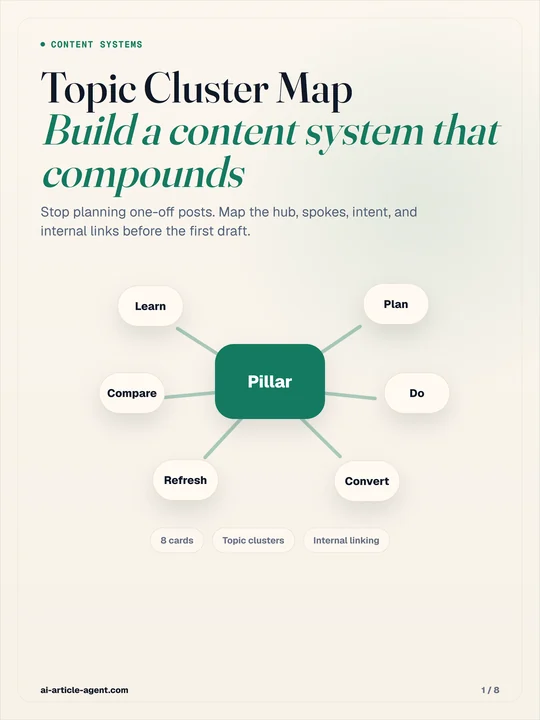
Topic Cluster Map: Build a Content System That Compounds
Use this 8-card visual playbook to turn scattered article ideas into a content cluster with clear roles, links, and a refresh loop.
What this tutorial teaches
This playbook turns topic clusters into an operational content map.
- Pick a pillar page with a useful boundary.
- Map spokes by intent, not just keyword similarity.
- Assign distinct roles so pages cooperate instead of cannibalizing each other.
- Use internal links and refresh reviews to make the cluster compound.
The short formula
Pillar page + intent-mapped spokes + page roles + internal links + refresh loop = a content system that compounds.
The goal is not to publish more pages. The goal is to make each new page strengthen the pages around it.
Text Transcript
Use this transcript as the searchable version of the carousel lesson.
Topic Cluster Map
Build a content system that compounds. Stop planning one-off posts. Map the hub, spokes, intent, and internal links before the first draft.
Random posts do not compound
A cluster gives every article a job: explain, compare, prove, convert, or refresh.
Choose a pillar page with boundaries
The pillar owns the main problem, but it should still be narrow enough for one audience to trust.
Map spokes by search intent
Group keywords by the job the searcher is trying to finish: learn, plan, compare, do, or buy.
Give every page a role
A cluster works when pages cooperate instead of competing for the same click.
Link like a map, not a pile
Internal links should explain relationships. They are navigation, context, and consolidation signals.
Ship a minimum viable cluster
Start with enough pages to prove the map: a pillar, three support pages, one comparison or example, links, and a review loop.
The topic cluster checklist
A content system compounds when every new page improves discoverability, depth, and trust for the pages around it.
Sources and Notes
This tutorial follows Google's people-first content guidance and practical SEO guidance around clear site structure, topic clusters, pillar pages, and internal links.