
This comprehensive guide provides solo founders and ecommerce store owners with a practical, step-by-step framework for building an independent website content calendar. Establishing a structured publishing schedule allows independent operators to systematically grow organic traffic, balance informational blog posts with transactional product pages, and safely leverage AI tools without risking search engine penalties. By implementing a lean content engine, solo founders can maintain consistent publishing, prevent creator burnout, and convert search intent into measurable revenue.
Organic search remains the dominant driver of website visitors, accounting for 53% of all website traffic globally in 2026, according to BrightEdge Research [I]. For an independent website, a consistent content calendar is the difference between relying on expensive paid ads and building a sustainable organic growth engine. Real-world data from Reboot Online and SEOvoyage indicates that the average ecommerce brand ranks for approximately 1,783 keywords, driving roughly 9,625 organic monthly visits. Consequently, establishing a structured publishing schedule is not a luxury; it is a core business requirement.
Building a content calendar for an independent website requires a lean approach: defining a Minimum Viable Strategy, mapping topic clusters to search intent, utilizing visual scheduling frameworks, and leveraging AI for heavy lifting while maintaining strict human editorial control. This guide covers how to define your strategy, balance blog posts with product pages, set up a visual calendar framework, safely integrate AI tools, and review monthly performance metrics.
The 5-Question Minimum Viable Strategy (MVS)
Overcoming Analysis Paralysis
Many solo founders stall before writing a single word because they overcomplicate the planning phase. They attempt to build multi-month, enterprise-grade content strategies that require hours of research. Experts point out that your initial strategy should and will change based on data once you start publishing. As one industry practitioner noted, "I know planning isn't as fun as posting, but trust me, it is crucial. And it doesn't need to be pages and pages long; just a couple of notes will help set you up for success..." [00:43]
Instead of drafting a 30-page strategy document, founders should answer five lightweight prompts to establish a Minimum Viable Strategy (MVS):
- Why are you doing this? (e.g., to build topical authority, capture email leads, or drive direct product sales).
- Who is the audience? (e.g., specific customer personas with clear pain points).
- What resonates with them? (e.g., step-by-step tutorials, comparison guides, or troubleshooting tips).
- Where do they hang out? (e.g., Google Search, specific subreddits, or email newsletters).
- How often will you post? (e.g., once a week for the blog, twice a week for social channels).
Defining Your Core Strategy
A common question among independent operators is: How far in advance should a solo founder plan their content calendar?
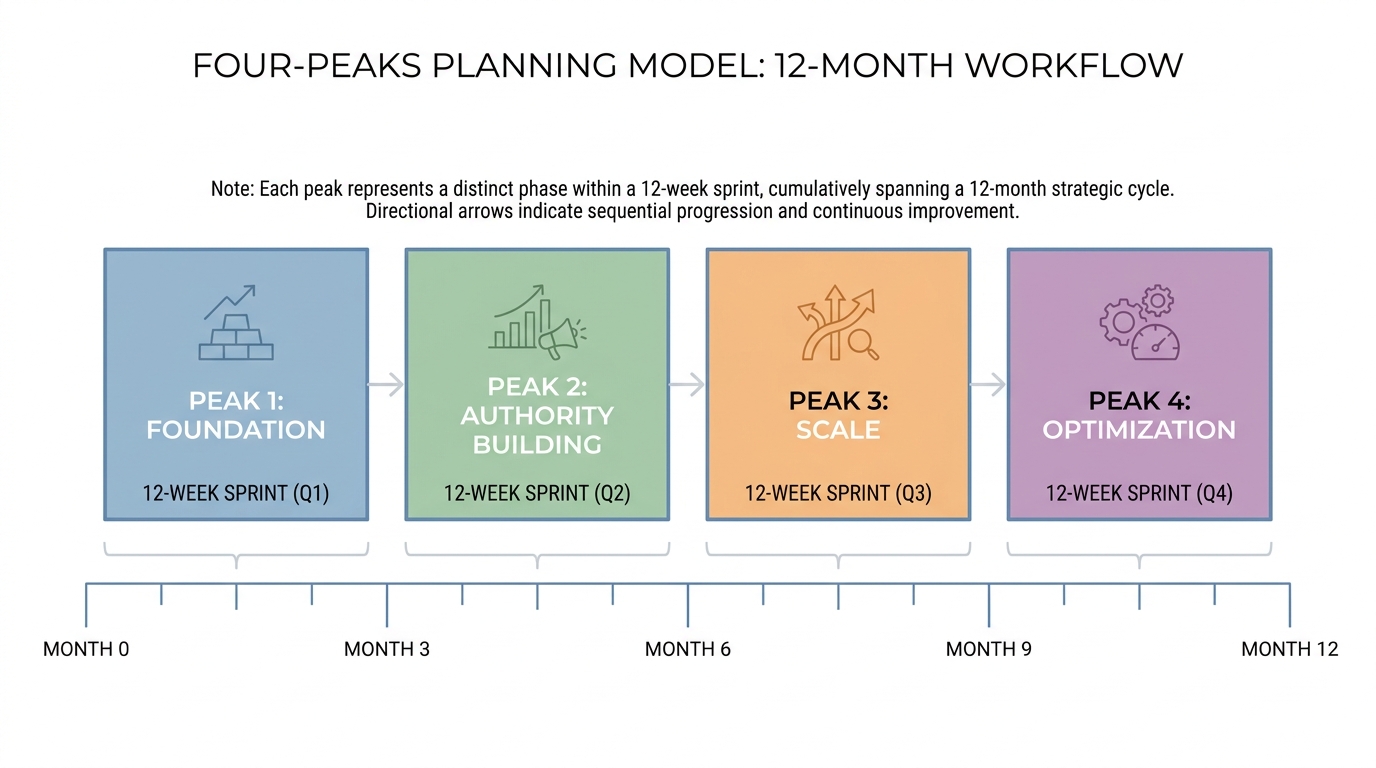
While enterprise brands plan a year in advance, solo founders should plan in 12-week sprints using the "Four-Peaks" planning model. This model anchors your content calendar around four major buying seasons or product launch windows per year. Planning in 12-week blocks provides enough structure to build topical authority while remaining agile enough to pivot when market trends shift.
Mapping Content to Search Intent and Topic Clusters
Informational Blogs vs. Transactional Product Pages
To build a calendar that drives revenue, you must understand search intent. Search intent is divided into informational (users seeking answers) and transactional (users seeking to buy).
According to a 2026 Seer Interactive study published via Search Engine Land, Google AI Overviews appear in approximately 36% of informational queries, which can reduce click-through rates (CTR) by up to 35% for top-of-funnel blog posts [III]. Conversely, AI Overviews trigger for only about 5% of transactional queries [III]. This means your bottom-of-funnel product pages are highly insulated from AI search disruption [III].
Consequently, solo founders must avoid keyword cannibalization—a common friction point where an informational blog post and a transactional product page compete for the exact same commercial keyword. For example, if you sell handmade leather boots, your product page should target "buy handmade leather boots" (transactional), while your blog post targets "how to care for handmade leather boots" (informational).
Building SEO Topic Clusters
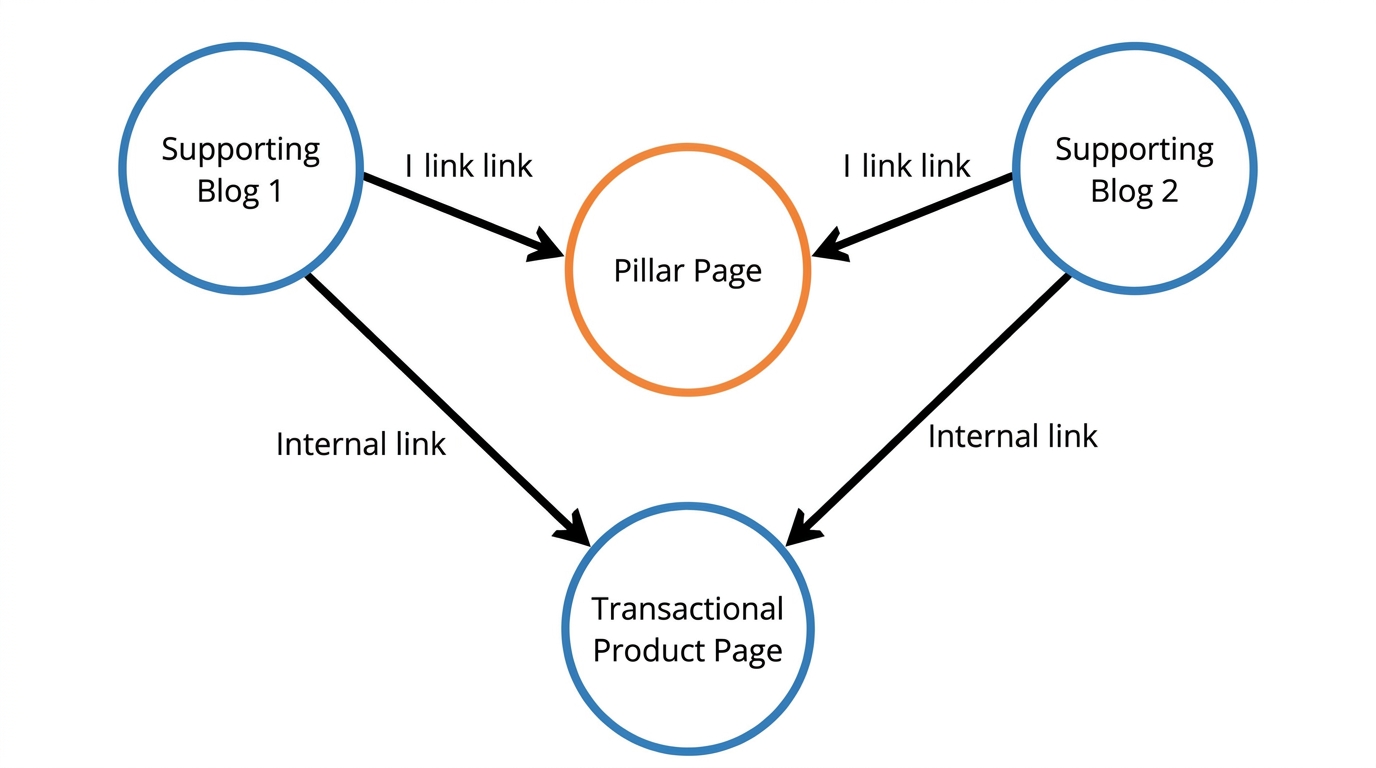
Topical authority is built by grouping related informational content into "topic clusters" that support your transactional pages. A topic cluster consists of a central "pillar" page (often a comprehensive guide or a main category page) linked to multiple supporting "sub-topic" pages (blog posts), which in turn link back to your transactional product pages.
For instance, if your primary product is an eco-friendly yoga mat, your topic cluster might look like this:
- Pillar/Category Page: Eco-Friendly Yoga Gear
- Supporting Blog 1: How to Clean a Natural Rubber Yoga Mat (Informational)
- Supporting Blog 2: Best Yoga Mats for Hot Yoga (Comparison/Informational)
- Target Product Page: Premium Natural Rubber Yoga Mat (Transactional)
What is the ideal ratio of informational blog posts to transactional product pages?
For most independent websites, a 3:1 ratio of informational to transactional content is optimal. This ratio allows you to build sufficient topical authority and capture top-of-funnel search traffic without neglecting the product pages that directly generate revenue.
Setting Up Your Content Calendar Framework
The "Brain Dump" Kanban Board
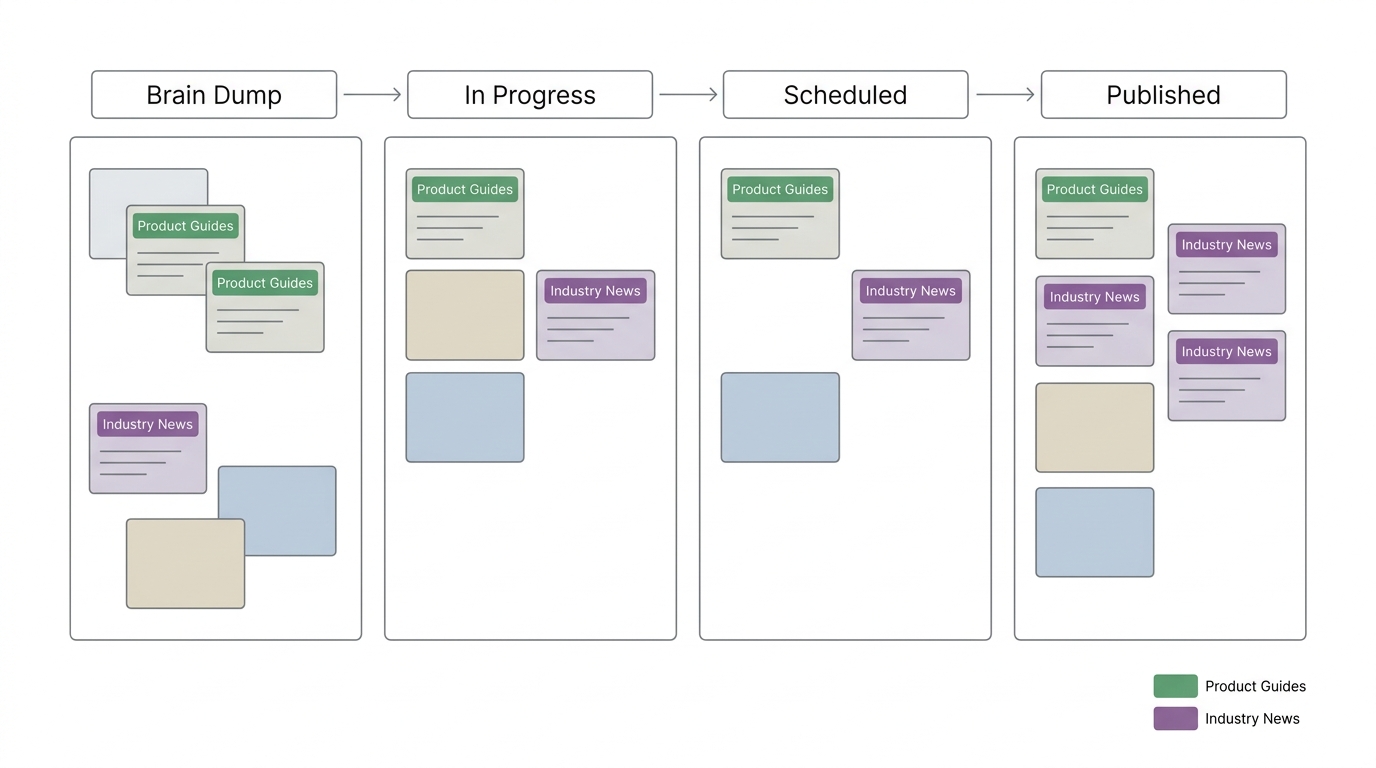
A functional content calendar requires a visual system that separates ideation from scheduling. In visual stress tests of efficient scheduling workflows, we observed that successful creators utilize a "Brain Dump" Kanban board. This is a dedicated "Create space" within your calendar tool (such as Notion, Trello, or Google Sheets) where rough ideas, links, and half-baked thoughts are stored. By keeping unassigned ideas in a visual holding pen, you prevent your active calendar from becoming cluttered and overwhelming.
Color-Coded Tags and Drag-and-Drop Agility
To maintain a balanced content mix, your calendar should utilize custom, color-coded tags for different content pillars (e.g., green for "Product Guides," purple for "Industry News," blue for "Customer Spotlights"). This visual mapping allows you to see at a glance if your content distribution is aligned with your goals.
Furthermore, your calendar must offer drag-and-drop agility. As one expert noted, "Nothing that is in your scheduled calendar that hasn't been published yet is set in stone... Social media is about staying agile." [05:42] If a sudden industry trend emerges or a product shipment is delayed, you must be able to click and drag scheduled posts to different slots without breaking your workflow.
📺 How To Create Your Social Media Calendar From Scratch | + Free Calendar Tool
The "Draft" Forcing Function
A highly effective scheduling hack is the "Draft" forcing function. This involves intentionally scheduling unfinished drafts directly onto your calendar grid, marked with a distinct blue "Draft" label. Placing a draft on a specific date acts as a psychological forcing function to compel you to complete the content, while serving as a visual reminder of upcoming publication slots.
However, there is a critical draft limitation "gotcha": drafts will not auto-publish. You must actively monitor your calendar and change the status of the post to "Scheduled" or "Published," or the scheduled slot will remain empty.
To help you map your content calendar effectively, use the following Content Intent & Format Matrix:
| Search Phase | Content Type | Primary Goal | Target Metric |
|---|---|---|---|
| Awareness | Informational Blog Post / Topic Cluster | Build topical authority & capture top-of-funnel traffic | Organic Impressions & Clicks |
| Consideration | Comparison Guide / Product Review | Address customer pain points & capture email leads | Email Sign-ups & CTR to Product Pages |
| Decision | Transactional Product Page / Landing Page | Convert search intent into direct product sales | Conversion Rate & Revenue |
The Solo Founder’s AI Content Workflow
Safe AI Ideation and Outlining
While enterprise brands deploy complex, multi-agent AI pipelines, solo founders require a lean, practical "solo founder AI" workflow. AI tools are highly effective for brainstorming topic clusters, generating content outlines, and overcoming blank-page syndrome. For example, you can prompt an AI model to generate ten informational sub-topics based on a primary transactional keyword.
Drafting and Repurposing Without Losing Brand Voice
Once an outline is generated, the founder must maintain strict editorial control during the drafting phase. AI can draft initial sections or repurpose a single comprehensive blog post into multiple supporting assets, such as email newsletters or social media updates, from a centralized hub. This centralization eliminates the manual copy-paste workflow and saves hours of administrative time.
Many founders fear that using AI will ruin their SEO rankings. In May 2026, Google published official documentation clarifying that AI-generated content is not inherently penalized. However, Google's Search Central spam policies strictly penalize "scaled content abuse"—defined as generating massive volumes of pages (via AI or automation) primarily to manipulate search rankings rather than help users [V].
Consequently, human editorial control is a mandatory safeguard. Every AI-assisted draft must undergo a rigorous human review process to inject unique brand voice, verify factual accuracy, and add real-world expertise.
Monthly Performance Review and Internal Linking
Essential Metrics for Solo Founders
Solo founders do not need complex analytics dashboards. Instead, focus on Google Search Console (GSC) data to track the performance of your 12-week sprints. Monitor three core metrics:
- Organic Impressions: Are your new topic clusters starting to appear in search results?
- Click-Through Rate (CTR): Are your titles and meta descriptions compelling searchers to click?
- Keyword Rankings: Is your site gaining topical authority for your target keywords?
Additionally, monitor the "Set and Forget" trap. You must actively monitor your calendar and performance metrics, and be prepared to pause your publishing queue or adjust messaging if global events occur, search algorithms shift, or a sudden industry trend emerges.
Optimizing the Internal Linking Strategy
To maximize the value of your content calendar, you must establish a robust internal linking strategy. Link equity (or "ranking power") flows from high-traffic informational blog posts to your transactional product pages. Ensure that every supporting blog post in a topic cluster contains at least one contextual link pointing directly to the target product page. This not only passes SEO authority but also guides interested readers directly down the sales funnel.
Summary and Next Steps
Building a lean content engine for an independent website does not require an enterprise budget. By establishing a 5-Question Minimum Viable Strategy, mapping topic clusters to search intent, utilizing visual Kanban boards, and safely integrating AI with strict human editorial control, solo founders can build a sustainable organic growth engine.
Before filling your new independent website content calendar with ideas, you need to know what your rivals are ranking for. Learn how to do an SEO competitor analysis to find your first batch of high-converting topics.
Frequently Asked Questions
How often should an independent website publish new content to see SEO results?
For most independent websites, publishing 1 to 2 high-quality, well-researched pieces per week is sufficient to build topical authority without causing creator burnout. Consistency is more important than sheer volume.
How do I avoid keyword cannibalization between blogs and product pages?
Ensure each page targets a unique search intent. Your product pages should target transactional keywords (e.g., "buy natural rubber yoga mat"), while your blog posts target informational keywords (e.g., "how to clean a natural rubber yoga mat"). Never optimize both pages for the exact same keyword.
Will using AI to write my blog posts get my site penalized by Google?
No, Google does not penalize AI content inherently. However, Google strictly penalizes "scaled content abuse"—the mass production of unedited pages designed solely to manipulate search rankings. To stay safe, always apply strict human editorial control to add unique value and brand voice.
What is the best free tool to build a content calendar from scratch?
For solo founders, free tools like Notion, Trello, or Google Sheets are excellent starting points. They allow you to build visual Kanban boards, apply custom color-coded tags, and maintain drag-and-drop agility without any software costs.
How long does it take for a new topic cluster to drive organic traffic?
Typically, it takes 3 to 6 months for search engines to crawl, index, and understand the relationship between pages in a new topic cluster. Tracking organic impressions in Google Search Console during the first 12 weeks will show if your strategy is moving in the right direction.
Turn keyword lists into publishable articles
Install AI Article Agent, upload your topics, and build a repeatable workflow from keywords to structured SEO articles.