
Website owners executing an SEO competitor analysis often discover that outranking massive domains requires identifying specific keyword gaps rather than matching enterprise marketing budgets.
SEO competitor analysis is the systematic process of reverse-engineering the websites that rank on the first page of Google to uncover keyword gaps, content opportunities, and backlink strategies. By analyzing organic search competitors, beginners can bypass high-difficulty terms and target long-tail queries where larger sites lack topical depth. This guide details a four-step framework to identify true SERP competitors, benchmark metrics accurately, and execute content strategies without triggering spam filters.
Business Competitors vs. Organic Search Competitors
Real-world business rivals compete for market share, whereas organic search competitors compete for specific keyword rankings on search engine results pages.
Why Real-World Rivals Are Not Always SEO Rivals
A common consensus among enthusiasts is that the companies you sell against locally or globally are rarely the exact same websites you compete against in the search results. A local hardware store might view another local hardware store as its primary business competitor. However, in the search engine results pages (SERPs), its primary rival for the query "how to fix a leaky PVC pipe" is likely a massive DIY blog, a manufacturer's website, or Wikipedia.
Industry tools quantify this distinction mathematically. The Semrush Knowledge Base notes that its "Competition Level" metric is calculated strictly based on the number of shared ranking keywords and the total keywords of each competitor, rather than real-world market share or revenue. Consequently, your SEO strategy must target the domains occupying the digital real estate you want, regardless of what those domains actually sell.
Identifying True SERP Competitors Using Seed Keywords
Experts point out that relying on assumed competitors is a critical error that skews subsequent data. Instead, analysts let the search data dictate the competitors.
In visual stress tests of SEO workflows, we observed analysts starting with a broad industry "seed keyword" (e.g., "sport clothes") in a database like Ahrefs Keyword Explorer. By analyzing the SERP overview for that specific term, they identify the exact domains that own the top spots. They then reverse-engineer those specific domains' strategies, ensuring their analysis is grounded in actual search performance rather than offline brand awareness.
The 4-Step SEO Competitor Analysis Framework
A structured competitor analysis isolates actionable data from vanity metrics, allowing website owners to prioritize content creation based on search intent and ranking probability.
📺 SEO Competitor Analysis (Create a Custom Google Sheet ...
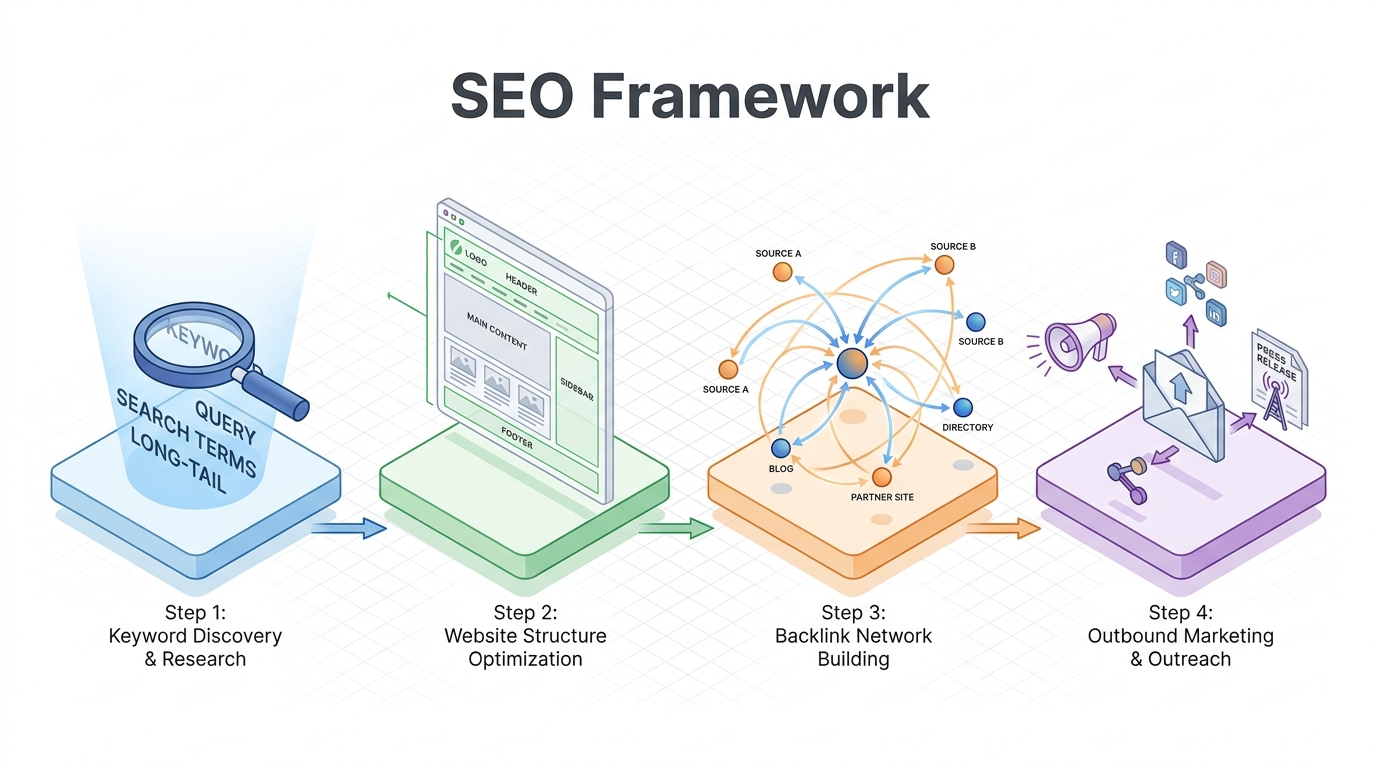
Step 1: Keyword Gap Analysis
Keyword gap analysis identifies search terms that competitors rank for, but your website does not, highlighting immediate opportunities for new content creation.
While many guides suggest targeting the highest volume keyword gaps, professional workflows actually require filtering these gaps by search intent and keyword difficulty. A keyword with 10,000 monthly searches is useless if the search intent is navigational (e.g., users looking for a specific competitor's login page). Filtering for informational or commercial intent ensures the gaps you target will actually yield engaged traffic.
Step 2: Content Gap Analysis via Top Pages
Content gap analysis evaluates the structural and informational deficiencies in a competitor's ranking articles to determine how your website can provide a more comprehensive answer.
In visual stress tests, we observed that analyzing a domain's overall metrics provides limited actionable data. Instead, navigating directly to a competitor's "Top Pages" report reveals the exact URLs driving the majority of their traffic, alongside the specific "Top keyword" associated with each page. This spec-to-scenario workflow allows a beginner to see exactly which individual articles are carrying the competitor's search visibility, rather than guessing based on the homepage.
Step 3: Backlink Profile Benchmarking
Backlink benchmarking involves analyzing the external websites linking to a competitor to identify replicable link-building opportunities such as niche directories or industry guest posts.
For enterprise websites with dedicated PR teams, acquiring links from top-tier news outlets remains the stronger choice because of the sheer volume of authoritative referring domains. However, for beginners who prioritize achievable growth, analyzing a competitor's mid-tier contextual links offers a more cost-effective path. By exporting a competitor's backlink profile, you can identify industry-specific blogs or resource pages that are statistically more likely to link to a newer website.
Step 4: Analyzing Outbound Marketing Beyond the SERPs
True competitor analysis extends beyond search rankings to evaluate how a rival converts the organic traffic they acquire into active users or subscribers.
Experts point out the "Add to Ahrefs and Forget It" trap. SEO tools only show search health; they leave you blind to active promotional strategies. To understand a competitor fully, analysts utilize platforms like Panoramata to track outbound marketing metrics such as "Emails Sent," "Average Spam Score," and "Promotions Rate." As one expert noted verbatim in a recent workflow demonstration: "We sometimes tend to add our competitors on Ahrefs and think that the job's done, that we are tracking our competitors if we are doing this, while... it's actually not really the case."
Analyzing Competitors Without Paid SEO Tools
Website owners can perform manual competitor analysis by using Google Search Console to identify their own ranking baseline, then using advanced Google search operators to find competitor content gaps.
Using Google Search Console and Manual SERP Analysis
Users on community forums often report that manual SERP analysis yields better qualitative insights than automated tool exports. By typing site:competitor.com "keyword" into Google, you can instantly see how many pages a competitor has dedicated to a specific topic. Furthermore, reviewing your own Google Search Console data reveals queries where your site ranks on page two or three. Comparing your page two content against the competitor's page one content highlights exact structural deficits—such as missing subtopics or inferior media integration.
The Competitor Prioritization Matrix
To prevent analysis paralysis when reviewing thousands of competitor keywords, plot the data into a structured decision framework based on Keyword Difficulty (KD) and Search Intent.
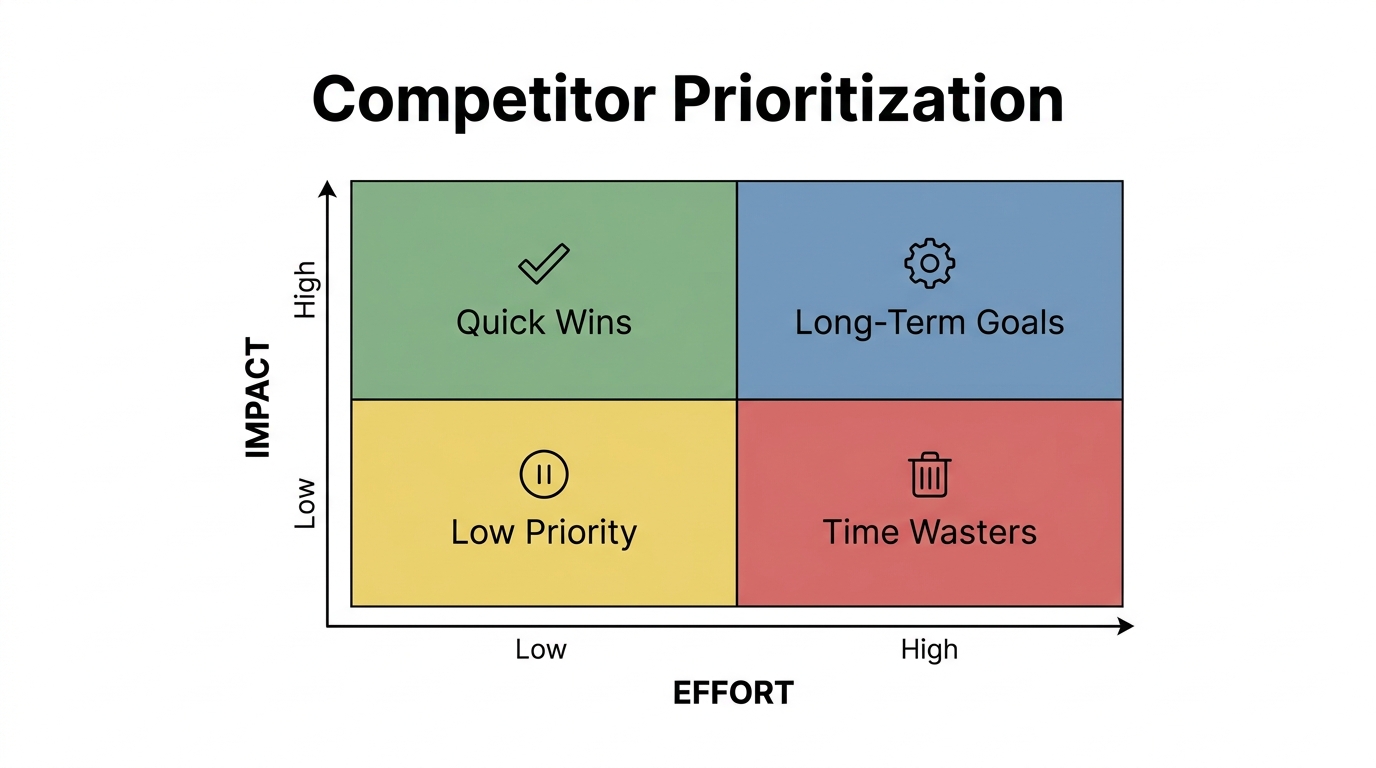
| Priority Level | Keyword Difficulty | Search Intent Match | Action Required |
|---|---|---|---|
| Quick Wins | Low | High (Commercial/Transactional) | Draft content immediately. These drive revenue with minimal link-building required. |
| Long-Term Goals | High | High (Commercial/Transactional) | Add to a 6-month roadmap. Requires dedicated link-building and topical clustering. |
| Low Priority | Low | Low (Broad Informational) | Assign to junior writers. Good for topical authority, but low direct conversion rate. |
| Time Wasters | High | Low (Navigational/Irrelevant) | Discard. Do not waste resources competing for terms that do not serve your audience. |
Understanding SEO Metrics
Third-party SEO metrics provide relative benchmarks for comparing domains, but they are not the actual algorithms search engines use to rank individual pages.
Domain Authority vs. Page Authority
Domain Authority and Page Authority are third-party predictive metrics used to estimate a website's ranking potential, not official metrics used by search engines.
Domain Authority (DA) is a proprietary 1-100 scale metric developed by Moz. According to Moz's official documentation updated in March 2025, "Unlike Google's ranking algorithms, Domain Authority is not a direct ranking factor." Beginners often experience friction when facing competitors with a DA of 80+. However, because DA is a relative benchmarking tool rather than an absolute truth, a highly relevant page on a DA 20 site can consistently outrank a generic page on a DA 80 site.
The Accuracy of Third-Party Traffic Estimations
Third-party SEO tools estimate traffic using predictive models and clickstream data, which provide relative benchmarks rather than exact visitor counts.
Industry studies from Collaborator.pro and Promodo (Dec 2024), alongside Topicfinder Semrush Data Analysis (April 2026), show that these predictive models can result in median deviations of up to 69% compared to actual Google Analytics data, especially for smaller sites. If a tool estimates a competitor receives 1,000 monthly visits, the actual number could be 300 or 1,700. Consequently, you should use these tools to confirm that Site A receives roughly twice the traffic of Site B, rather than relying on them for absolute traffic reporting.
Beating High-Authority Competitors
Smaller websites outrank high-authority domains by targeting highly specific, multi-word queries that massive brands fail to answer comprehensively.
Targeting Long-Tail Keywords and Specific Search Intent
Massive domains often rank for broad terms because of their sheer backlink volume, but they rarely update their content to address granular user questions. If a high-authority competitor has a generic 500-word article on "running shoes," a beginner can capture traffic by writing a highly specific, 2,000-word guide on "best running shoes for flat feet on concrete." This satisfies a specific search intent that the broader article ignores.
Building Deeper Topical Authority
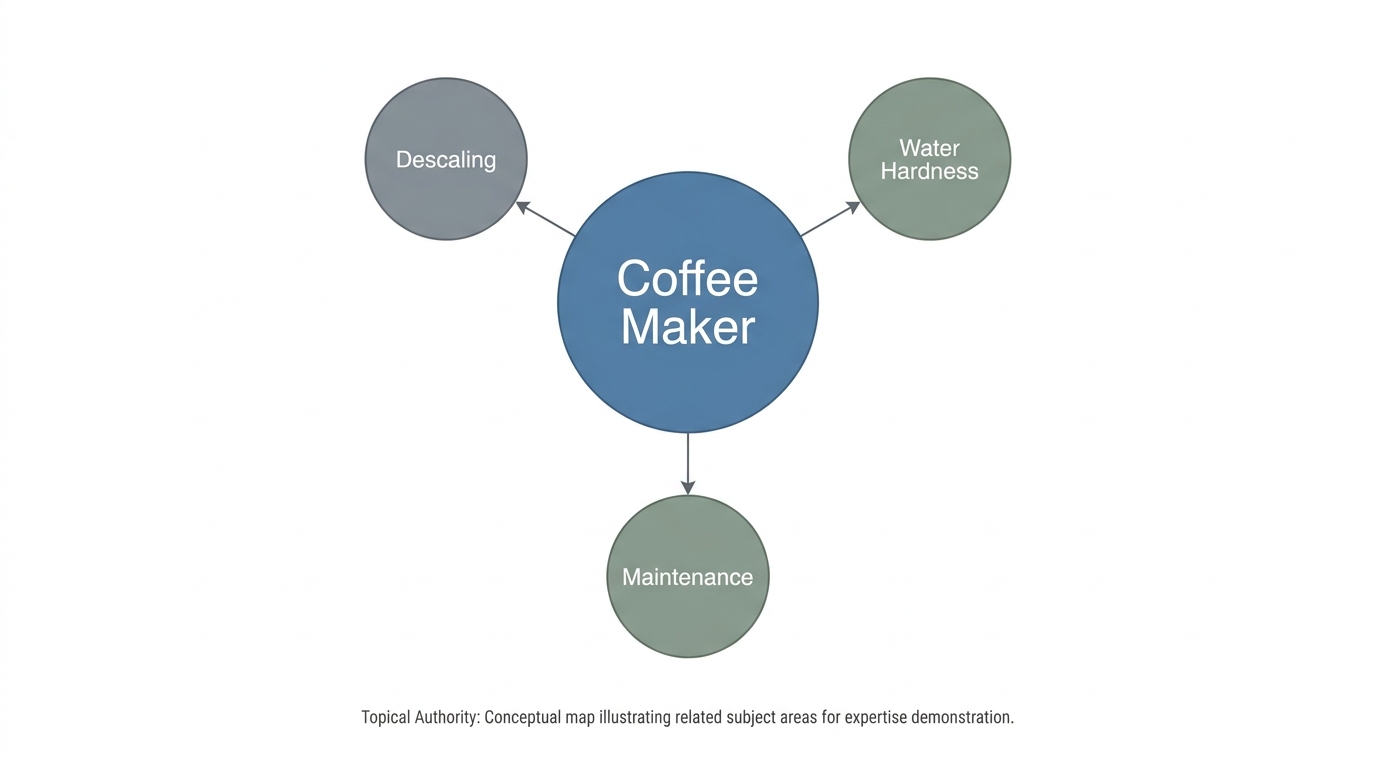
Topical authority is established by publishing a comprehensive cluster of interconnected articles on a narrow subject, signaling expertise to search engines.
A high-authority news site might publish one article about "how to clean a coffee maker." Conversely, a beginner's coffee blog can publish 30 interconnected articles covering descaling solutions, water hardness impacts, and brand-specific maintenance. Search engines recognize this dense entity graph and will often rank the specialized smaller site over the generalized larger site for niche queries.
Avoiding the Duplicate Content Trap
Search engines consolidate similar pages rather than penalizing them, but deliberately scraping competitor content violates spam policies and triggers manual ranking drops.
Google has officially confirmed there is no algorithmic "duplicate content penalty" for covering similar topics. If you and a competitor both write about the same subject, Google simply picks one canonical URL to rank. However, under the Google Spam Policies updated in 2025, deliberately copying competitor pages violates "Scaled Content Abuse" and "Scraped Content" guidelines. To remain compliant, use competitor content strictly to identify informational gaps, ensuring your final publication adds unique value, original research, or a superior user experience.
Next Steps for SEO Competitor Analysis
Executing an SEO competitor analysis requires distinguishing between real-world rivals and actual SERP competitors. By leveraging keyword gap analysis, benchmarking backlink profiles, and understanding the limitations of third-party traffic estimations, website owners can systematically dismantle the strategies of high-authority domains. The objective is never to copy a competitor, but to identify the specific queries they have failed to answer comprehensively.
To put this framework into practice, begin by mapping out your core topics. Read foundational guides on keyword research, or start building your own Competitor Tracking Spreadsheet using Google Sheets to monitor the top three domains in your specific niche.
Frequently Asked Questions
Can I do a complete competitor analysis without expensive paid tools?
Yes. While paid tools expedite data gathering, you can perform a thorough analysis using Google Search Console, manual SERP evaluation, and free spreadsheet templates to track content gaps and ranking changes.
How often should I conduct an SEO competitor analysis?
A comprehensive analysis should be conducted quarterly. However, monitoring a competitor's new content publications and major outbound marketing campaigns should be an ongoing monthly process.
What if my organic competitors are massive brands like Wikipedia or Amazon?
Do not attempt to outrank them on broad, high-volume keywords. Instead, target long-tail, highly specific queries where these massive brands lack detailed, expert-level content.
Will I get penalized by Google if my content is too similar to a competitor's?
There is no algorithmic penalty for covering the same topic. However, scraping or rewriting their text without adding unique value violates Google's spam policies and can result in manual ranking drops.
How do I prioritize which competitor keywords to target first?
Use a prioritization matrix. Focus first on "Quick Wins"—keywords with low ranking difficulty and high commercial intent—before dedicating resources to highly competitive, broad informational terms.
Turn keyword lists into publishable articles
Install AI Article Agent, upload your topics, and build a repeatable workflow from keywords to structured SEO articles.