
To achieve AI search visibility, content strategies must shift from ranking isolated pages to building interconnected knowledge graphs. AI search engines—such as Google’s AI Overviews, Perplexity, and ChatGPT—do not evaluate single pages in a vacuum. Instead, they assess semantic relationships and topical depth across an entire domain. Building topic clusters is the most effective way to structure your website so that Large Language Models (LLMs) can discover, understand, and cite your content as a definitive answer.
This guide breaks down the mechanics of AI search, the data behind topic clusters, and the exact technical and content frameworks required to optimize your site for generative engines.
The Mechanics of AI Search: Query Fan-Out and Parallel Retrieval
Traditional search engines operate on a 1:1 keyword matching system, retrieving a list of links based on specific search terms. AI search engines operate differently through a process known as "Query Fan-out."
When a user inputs a complex prompt, the AI breaks that single query into multiple parallel subqueries, exploring different facets, angles, and intents simultaneously. Expert demonstrations of this parallel retrieval process visualize it as a "Hub and Spoke" model.
📺 Why Topic Clusters Matter More Than Ever in AI Search ...
The AI engine fetches information from diverse sources covering these various subqueries and synthesizes them into one comprehensive answer.
Because AI synthesizes answers from multiple angles, a single long-form article is rarely enough. To be cited, a website must provide a comprehensive pillar page (the Hub) surrounded by specific cluster pages (the Spokes) that cover every nuanced sub-area. This architectural requirement is the driving force behind the transition from traditional search tactics to Generative Engine Optimization (GEO), where understanding the difference between GEO vs SEO is critical for modern visibility.
The Data Behind Topic Clusters in the AI Era
The shift toward topic clusters is backed by compelling data regarding how LLMs select their sources. Recent industry analyses of AI citations reveal a stark preference for interconnected content:
- Citation Multipliers: Websites utilizing a topic cluster architecture receive approximately 3.2× more AI citations than competitors relying on single-page optimization.
- The 5-Page Threshold: Up to 86% of AI citations originate from websites that feature at least five interconnected pages dedicated to a specific topic.
- Bidirectional Linking: Implementing bidirectional internal linking (linking from the pillar to the cluster, and from the cluster back to the pillar) increases the probability of an AI citation by 2.7×.
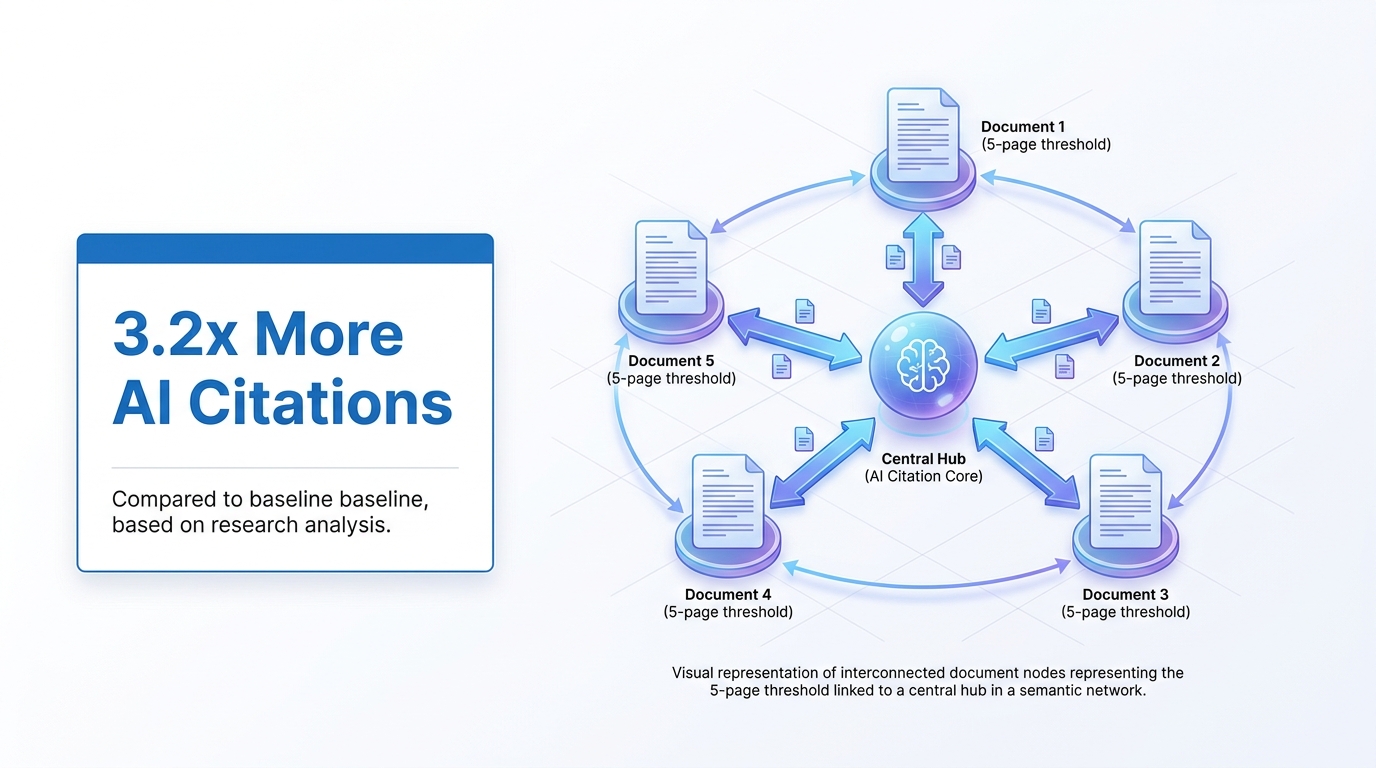
LLMs reward depth over volume. A tightly woven cluster of 5 to 10 highly relevant articles establishes the semantic relevance and entity relationships required to act as a "digital lighthouse" for AI crawlers.
The 4-Pillar GEO Funnel for Topic Clusters
To understand where topic clusters fit into your broader strategy, it is helpful to view them through the "GEO Funnel," which dictates how AI systems process information:
- Discover (Technical): The AI must be able to crawl your site. This requires clean architecture, raw HTML availability, and protocols like
LLMs.txtto guide AI crawlers. - Understand (Content & Entity): This is where topic clusters live. By grouping a broad pillar page with 5–10 deep-dive cluster pages, you map out entity relationships so the AI understands your topical breadth.
- Trust (Brand Authority): The AI validates your cluster's authority using off-page entity signals, such as mentions on Reddit, G2, or third-party review sites.
- Cite (Visibility): Once the AI discovers, understands, and trusts your cluster, it extracts passages to form its generated response, resulting in a citation.
Structuring Your Hub and Spoke Architecture
A successful topic cluster requires a strict hierarchy. The standard recommendation is a ratio of one core pillar page interlinked with 5 to 10 related cluster blogs.
- The Pillar Page: Answers the broad "What is X?" question. It serves as the comprehensive overview.
- The Cluster Pages: Deep dives into specific subtopics, typically 800–1,500 words in length.
Example Architecture:
If you are building a "Gourmet Coffee Hub," the pillar page would be a definitive guide to gourmet coffee beans. The cluster pages would cover specific brewing methods (e.g., "How to Brew Pour-Over Coffee," "French Press vs. Aeropress"). For an e-commerce site, a pillar might be a "Hiking Boots Buying Guide," with clusters dedicated to "Best Hiking Boots for Wide Feet" or "Waterproofing Hiking Boots."
The "Traffic-Chasing" Warning:
When ideating clusters, map them directly to actual customer journey questions rather than abstract keyword volume. Observed tests from the December 2023 Google Core Update showed that highly authoritative brands suffered massive traffic drops because they published high-volume cluster content that was entirely disconnected from their core product or business intent. If your subtopics lack relevance to your core business entity, AI search engines will ignore them.
Formatting Cluster Pages for AI Extraction
Creating the content is only half the battle; formatting is foundational for AI extraction. LLMs do not read pages like humans; they parse structured data and extract specific passages. To win citations, you must engage in passage-level optimization.
- Conversational Headings: Use H2s and H3s that ask real user questions (e.g., "What is the best temperature for brewing coffee?").
- Direct Answers: Immediately beneath the heading, provide a concise, 40-60 word direct answer. This format is highly favored by AI models looking for quick, authoritative summaries.
- Bite-Sized Blocks: Break long paragraphs into focused sections. Avoid walls of text. Use bolded summaries at the start of each section to highlight key entities.
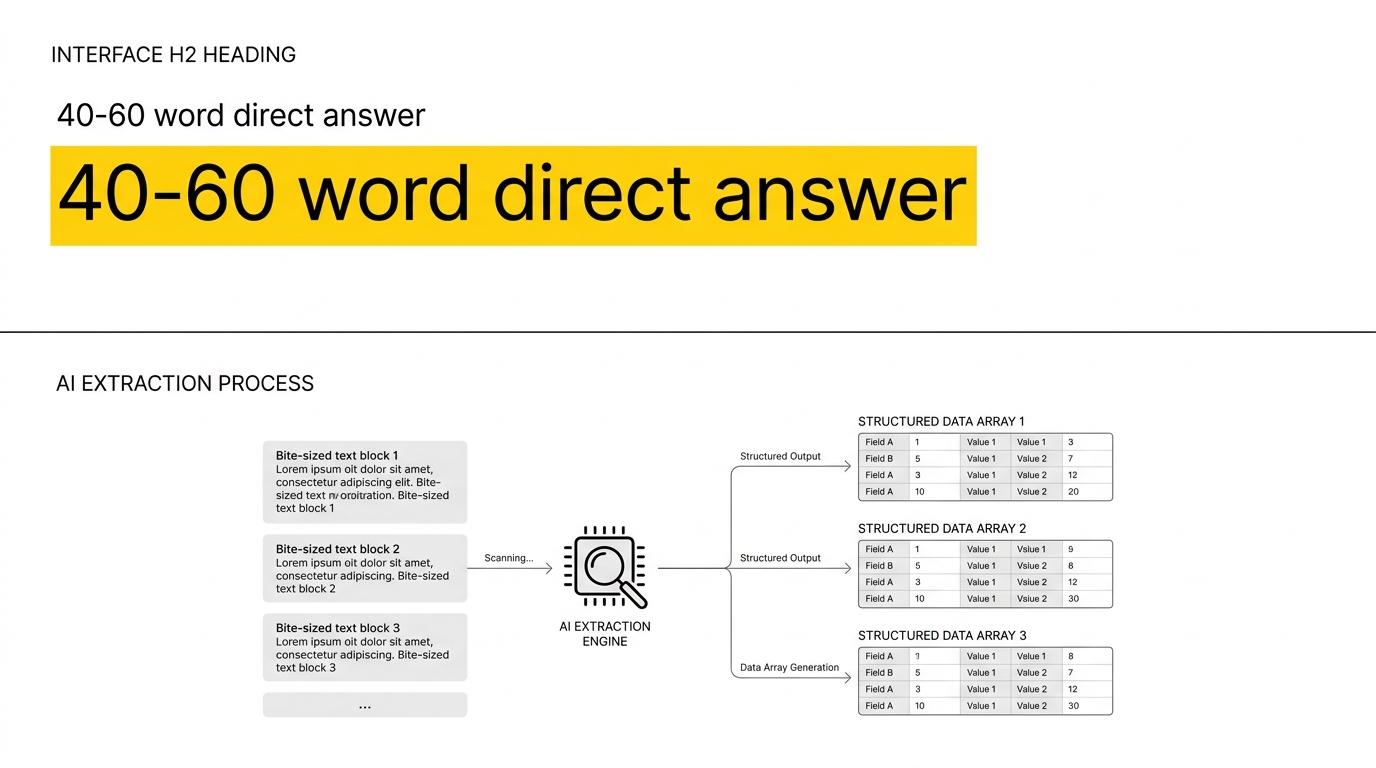
To ensure your content is machine-readable and structured for extraction, you must optimize AI-generated articles and human-written content for Google AI Overviews by aligning your formatting with the exact patterns LLMs are trained to recognize.
Technical Signals: Schema, LLMs.txt, and Entity Validation
To ensure your topic clusters are fully machine-readable, integrate the following technical signals:
- Schema Markup: Schema is a secret weapon for AI search. Align your schema directly with your topic clusters using
FAQPage,Article,HowTo, andJSON-LDfor products. This turns your text into structured data. - The LLMs.txt Protocol: An emerging standard for 2026, the
LLMs.txtfile sits in your root directory (similar to robots.txt) and provides explicit instructions to AI crawlers on how to read and interpret your site's content and cluster relationships. - Raw HTML: Ensure key cluster content is visible in raw HTML. Many AI systems still struggle to process JavaScript-rendered content efficiently.
Structured Decision Aid: AI Topic Cluster Implementation Checklist
Use this matrix to audit your topic clusters for AI search readiness.
| Optimization Phase | Action Item | AI Search Benefit |
|---|---|---|
| Architecture | Build 1 Pillar Page linked to 5–10 Cluster Pages. | Proves topical depth and semantic relevance to LLMs. |
| Internal Linking | Implement bidirectional linking (Pillar ↔ Cluster). | Increases AI citation probability by mapping entity relationships. |
| Formatting | Use question-based H2/H3s followed by 40-60 word direct answers. | Facilitates passage-level extraction for AI Overviews. |
| Technical | Apply FAQPage, Article, or JSON-LD schema markup. |
Translates unstructured text into machine-readable data. |
| Validation | Cultivate off-page mentions (Reddit, industry forums) for the topic. | Builds the "Trust" pillar of the GEO funnel via third-party validation. |
What to Ignore in AI Search Optimization
As search evolves, several legacy SEO tactics have become obsolete or actively harmful when optimizing for AI visibility:
- Keyword Density: Ignore traditional keyword stuffing. AI models evaluate semantic relevance, entity recognition, and context, not how many times a specific phrase appears.
- Isolated Single-Page Optimization: Do not attempt to rank a single "mega-page" for a complex topic without supporting clusters. AI evaluates the entire domain's coverage of a topic.
- Chasing Irrelevant High-Volume Traffic: Ignore high-volume keywords that do not align with your core business entity. AI search engines penalize "disconnects" between your brand's established authority and off-topic content.
Frequently Asked Questions (FAQs)
What is the difference between a Citation and a Mention in AI search?
A citation occurs when an AI search engine uses your content as direct input to generate its answer, usually providing a clickable link or card to your site. A mention is simply when the AI drops your brand name in the text without using your content as the source material or linking back to you. GEO focuses on earning citations.
How many pages do I need in a topic cluster for AI visibility?
Data indicates that AI search engines strongly prefer clusters with a minimum of 5 interconnected pages (1 pillar and at least 4-5 supporting clusters). Sites hitting this threshold generate the vast majority of AI citations.
Does JavaScript rendering affect AI search visibility?
Yes. While traditional search engines like Google have improved their ability to render JavaScript, many newer AI crawlers and LLMs struggle with it. Key cluster content and internal links must be visible in raw HTML to ensure they are discovered.
How do LLMs evaluate topical authority?
LLMs evaluate authority by analyzing semantic depth, the presence of related entities, structured data, and off-page validation. They look for a comprehensive "Hub and Spoke" architecture that thoroughly covers all subqueries related to a primary topic.
What is "The Great Decoupling" in AI search?
The Great Decoupling refers to the phenomenon where AI Overviews and generative answers reduce traditional organic click-through rates (as users get answers directly on the search page) while simultaneously increasing brand visibility and trust for the sites that are cited as sources.
Turn keyword lists into publishable articles
Install AI Article Agent, upload your topics, and build a repeatable workflow from keywords to structured SEO articles.